


![PP - Logo - Website Coloring [Overlay].png](https://static.wixstatic.com/media/382ad7_2960eb55687f4ce0b60fa0e0fa842189~mv2.png/v1/crop/x_0,y_22,w_1920,h_154/fill/w_600,h_48,al_c,q_85,usm_0.66_1.00_0.01,enc_avif,quality_auto/PP%20-%20Logo%20-%20Website%20Coloring%20%5BOverlay%5D.png)

WHEN AMERICA HEARD CRICKETS
- Gabe Ryan

- May 21, 2024
- 6 min read
A Prairie Tragedy in Several Acts: The Strange, Loud Silence Around Kristi Noem
Somewhere out on the prairie, when the wind dies and the sky turns black enough to swallow the stars, you can hear them.
Crickets.
That thin electric hum that fills the empty spaces of the American night. A chirping Greek chorus of insects keeping time with the slow heartbeat of the plains.
Normally it’s the sound of quiet. The sound of nothing happening. The sound of the world hitting pause.
But in the political saga of Kristi Noem, the cricket soundtrack plays a different tune entirely—less peaceful prairie lullaby, more political alarm clock buzzing in the dark.
Because when the story of the governor’s memoir hit the national bloodstream—when readers discovered the anecdote about a dog named Cricket—the reaction across the country wasn’t quiet at all.
It was deafening.
Cable news panels started barking. Comment sections howled. Political reporters chased the story like a pack of bloodhounds that had just picked up a scent blowing across the prairie wind.
And somewhere in the middle of that media dog park, the carefully groomed political brand Kristi Noem had spent years raising—prairie toughness, ranch realism, frontier decisiveness—started making a strange, grinding noise.
The kind of noise you hear right before the crickets start...
...or, in this case, right after someone mentions Cricket.
The Myth of the Prairie Governor
![[Photo Credit: ChatGPT]](https://static.wixstatic.com/media/382ad7_22ef198cbcb94fe79c2bf9f9b29bd404~mv2.png/v1/fill/w_980,h_653,al_c,q_90,usm_0.66_1.00_0.01,enc_avif,quality_auto/382ad7_22ef198cbcb94fe79c2bf9f9b29bd404~mv2.png)
Every political career begins with a story.
For Noem, the story has always been the same familiar prairie yarn: ranch kid from South Dakota, tragedy in the family, responsibility arriving early, the windswept plains shaping a no-nonsense personality tougher than a fence post in January.
It’s an archetype older than the country itself.
Hard land makes hard people. Hard people make decisive leaders. And decisive leaders don’t sit around twiddling their thumbs while the political dogs bark.
When Noem entered the South Dakota legislature in 2006, she was a relatively unknown figure outside the state. A small-town political pup still finding her footing.
But by the time she reached Congress in 2010, the brand was already forming.
The rancher.
The straight shooter.
The political watchdog guarding the prairie gates.
The politician who understood rural America because she came from it—and because she knew which end of the leash to hold.
It was good branding. In a political world increasingly dominated by Ivy League résumés and think-tank jargon, the image of a rancher with dusty boots and a rifle slung over her shoulder had real bite.
Authenticity sells.
At least until the internet starts sniffing around.
Pandemic Fame & the
Conservative Spotlight
Before the memoir.
Before the dog.
Before the national chorus of metaphorical crickets.
Noem’s rise to national attention began during the loudest political storm in decades.
The COVID pandemic.
While governors across the country imposed shutdowns, restrictions, and mask mandates, Noem chose another trail through the tall grass. She resisted statewide lockdowns and framed the decision as a defense of personal freedom.
Conservative media ate it up like a pack of hungry prairie coyotes.
Television appearances multiplied faster than prairie dogs popping out of holes. Political conferences booked her as a headline act. Commentators began whispering that the governor from the plains might someday run with the big dogs in national politics.
Some even speculated about a future ticket aligned with Donald Trump.
For a governor of a sparsely populated prairie state, it was a remarkable transformation.
Suddenly the ranch governor from the Dakotas was everywhere—on screens, at conferences, riding the wave of national attention like a cowboy on a jittery bronco.
But fame is a tricky animal.
Feed it too much attention and it starts wagging the dog.
And once the spotlight hits, every detail gets sniffed out.
Every anecdote.
Every claim.
Every strange little story hiding in the tall grass of a memoir manuscript.
Her Memoir? Shoot & a Miss
The memoir was supposed to be the next step in the political obedience school curriculum.
Every rising political star eventually writes one. It’s part autobiography, part campaign introduction, part myth-polishing exercise.
A chance to tell your story before someone else starts barking about it.
But when readers cracked open Noem’s book, they found something unexpected buried among the political lessons and prairie nostalgia.

A story about a dog named Cricket.
And suddenly the quiet prairie narrative began chirping very loudly.
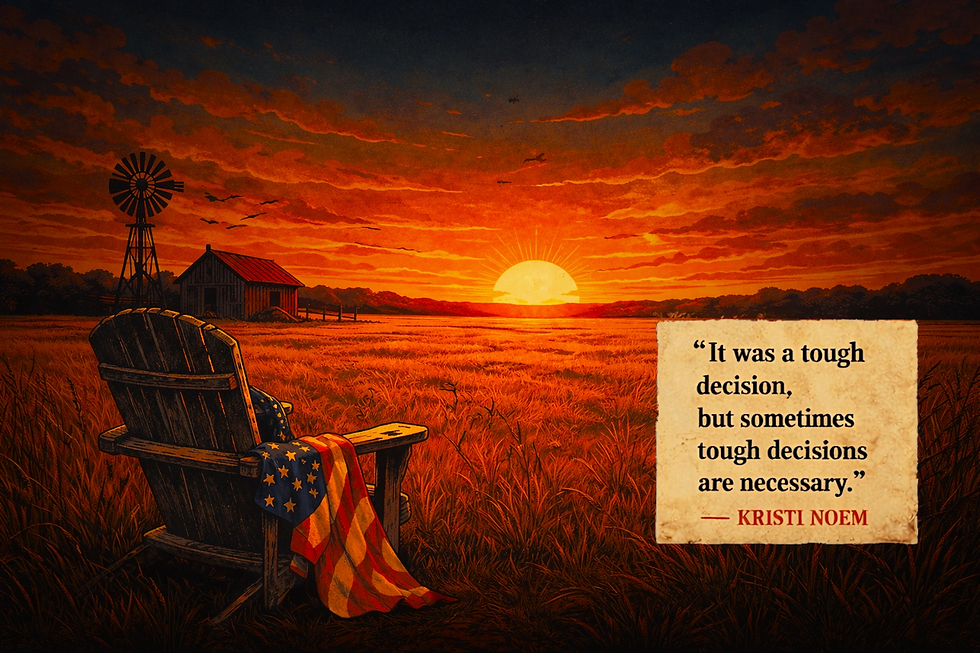
In the anecdote, Noem described killing the dog after it allegedly behaved aggressively during a hunt and killed chickens on her property. She framed the decision as a difficult but necessary act of ranch responsibility.
In other words: tough leadership. Frontier realism. Sometimes the ranch boss has to make the hard calls. But the national reaction was anything but obedient.
Within hours, journalists, commentators, and animal-welfare advocates were circling the story like a pack of investigative hounds.
The internet, never one to miss a good bone, seized on the name immediately.
Cricket.
The metaphor practically wrote itself.
Political strategist Rick Wilson posted online that including the anecdote in a memoir might be “one of the strangest self-inflicted political wounds in recent memory.”
Late-night comedians chewed on the story for days.
Memes spread across social media like fleas at a kennel convention.
For a politician trying to introduce herself to the country, the rollout had gone to the dogs.
And the crickets were only getting louder.
The Kim Jong Un
Chapter That Vanished
Just when the Cricket story seemed like the loudest chirp in the prairie night, journalists found another strange detail hiding in the manuscript’s tall grass.
An early draft of the memoir referenced a meeting between Noem and Kim Jong Un during her time in Congress.
There was just one small hitch.
Reporters couldn’t find evidence that the meeting had ever happened.
When questions began flying faster than grasshoppers in July, the publisher quietly removed the passage from the final version of the book, explaining that it should not have been included.
That explanation did not exactly quiet the kennel.
Political memoirs go through armies of editors, fact-checkers, ghostwriters, and proofreaders. Details about meetings with world leaders usually don’t sneak in unnoticed like a stray mutt under the fence.
The revelation turned what should have been a routine book launch into a full-blown credibility chew toy.
Suddenly the memoir meant to elevate Noem onto the national stage was being inspected like a suspicious chew bone.
Every anecdote.
Every claim.
Every paragraph.
And the louder the media pack barked, the louder the metaphorical crickets seemed to chirp in the background.
The Optics Machine
![[Photo Credit: ChatGPT]](https://static.wixstatic.com/media/382ad7_87793b95ad144bed85955f7cc2df71af~mv2.png/v1/fill/w_980,h_653,al_c,q_90,usm_0.66_1.00_0.01,enc_avif,quality_auto/382ad7_87793b95ad144bed85955f7cc2df71af~mv2.png)
Critics of Noem often argue that her political strategy leans heavily on symbolism.
Photos of her riding horses.
Campaign videos framed like Western movie trailers.
Appearances in tactical gear during border visits that critics described as political theater—or, less charitably, a kind of frontier cosplay.
In the age of Instagram politics, optics are the leash that guides the whole show.
One columnist in the Sioux Falls Argus Leader described the aesthetic as “somewhere between governance and Instagram cosplay,” a comment that circulated through political media like a tennis ball tossed into a yard full of dogs.
Supporters, of course, saw something entirely different.
To them, the imagery reinforced the authenticity of the prairie governor persona.
Boots, horses, open land—the visual language of rural America.
Politics, like dog training, often comes down to signals & responses.
Show the right image, and the base wags its tail.
Show the wrong one, and the critics start barking.
Budgets, Ads & the
Politics of Promotion
Another line of criticism centered on spending decisions during Noem’s tenure.
South Dakota funded advertising campaigns promoting tourism and the state’s open-for-business image during the pandemic.
Supporters argued the campaigns helped the economy and brought visitors sniffing around the prairie.
Critics countered that the ads sometimes looked suspiciously like national political branding—less “Visit South Dakota,” more “Meet the Governor.”
During legislative hearings, one Democratic lawmaker remarked that some ads seemed designed less to attract tourists than to introduce the governor to voters outside the state.
In other words: less travel brochure, more campaign dog whistle.
The governor’s office rejected that characterization.
But the debate fed the perception that Noem’s ambitions were roaming beyond the prairie fence.
![[Photo Credit: ChatGPT]](https://static.wixstatic.com/media/382ad7_838b1d466e924415a6ca5b95931913e6~mv2.png/v1/fill/w_980,h_653,al_c,q_90,usm_0.66_1.00_0.01,enc_avif,quality_auto/382ad7_838b1d466e924415a6ca5b95931913e6~mv2.png)
The Sound of Crickets
Which brings us back, inevitably, to the chirping.
Crickets.
In American slang, hearing crickets usually means silence—an awkward pause after someone says something that lands badly.
A joke that flops.
A comment that makes the room uncomfortable.
In the saga of Kristi Noem, the metaphor gained a strange double meaning.
There was Cricket the dog.
And then there was the sound of the national conversation that followed.
Not quiet, exactly.
But a peculiar mix of outrage, disbelief, and the long, uneasy pause that settles over the prairie when the public is still trying to figure out whether what it just heard was real.
Because when a political story starts with a dog named Cricket…
…and ends with the entire country hearing crickets…
you know the narrative has taken a strange turn somewhere along the trail. And sometimes—if the internet is paying attention—the entire episode becomes something stranger.
A cultural artifact.
A metaphor.
A story that refuses to stop echoing.
Because once the country starts hearing crickets, it’s hard to make them quiet down again.
And somewhere out on the prairie tonight, beneath a sky big enough to swallow a thousand political headlines, the real crickets are still chirping.
Steady.
Unbothered.
Endlessly repeating the same small sound.
The soundtrack of silence.
The soundtrack of awkward pauses.
The soundtrack of a political moment that will likely be remembered for a very, very long time.
Chirp.
Chirp.
Chirp.



Comments